At this time in 1913, Erik Satie began composing Embryons Desséchés, a triptych for piano. He would finish it in two months, inspired by words for strange crustaceans discovered in his Larousse dictionary, using these words as entry-points for an ironic portrait of Classical musicians and pieces. When asked about memorable images, Jorge Luis Borges remembered the tigers in illustrated versions of childhood encyclopedias better than “the eyes or the smile of a woman.”
Jak Satie vysvětluje dílo
This work is absolutely incomprehensible, even to me. Of a singular depth, it always amazes me. I wrote it in spite of myself, driven by destiny. Maybe I wanted to be humorous? It would not surprise me and would be quite in my way. However, I will have no mercy for they who would ignore.
První embryon, D’Holothurie
The first dryed-up embryo, “D’Holothurie”, is about a sea cucumber observed in the Bay of Saint-Malo, and Satie parodies here a popular 1830 French song, Loisa Puget’s "Mon rocher de Saint-Malo", by using it as the second subject in the dominant, while keeping the accompaniment in the tonic. The parodic final cadence builds on Puget’s refrain before ending pompously and repeatedly in the wrong key, which Satie has made to sound like the right one.
D’Edriopthalma a třetí Embryo
The second embryo, “d’Edriopthalma,” focuses on a crustacean with immobile eyes. Rather than parodying the "celebrated Mazurka by Schubert", as written in the score, Satie actually pokes fun at the famous funeral march from Chopin's sonata Op.35, rendering the soaring trio melody flat, mundane, and un-Romantic. Elements of Chopin’s posthumous funeral march (1837, op.72 No. 2) also appear in this creature with immobile eyes.
The third embryo, “De Podohthalma”, another crustacean with eyes on slim stalks, eyes held apart from the rest of the body, quotes the refrain from Fiametta’s “Orang-utang Song” (in Edmund Audran’s operetta, La Mascotte, 1880), where the orang-utang puts on pants to become an official councillor, a legitimate member of the Court that poses no threat to the established members - because he agrees to wear the costume. Backstory here includes the French song "Good King Dagobert" ("has put his culottes on backwards..."), written in the eighteenth century to mock the figure of the King.
The final cadence, “Cadence obligee (de l’auteur), or mandatory cadence by the author, parodies the 23 "ad libitum" optional cadences, found in certain virtuoso romantic piano works, particularly the finale of Beethoven’s Eighth Symphony.
Ovlivnění a výklad interpretů
“The most challenging part of playing this piece by Satie is deciding on how to add timing. Satie doesn’t give us time signatures, so lots of this is left to the individual performer, including how much we want to parody the parodies.” - My son on preparing to play Embryons Desséchés.
Další vrstvy literárního kontextu
V roce 1991 Eliot Weinberger publikoval collage-essay “Dreams from the Holothurians,” který sleduje mýt Atlantis skrze výpovědi průzkumníků, politiků, náboženských vůdců, filozofů a myslitelů. Atlantis! Herodotos vypráví o lidech na západě, Atarantes, a Atlantes, kteří jedí nic živého a nikdy nesní. Weinerberská linie se proplétá až k holothurians a končí v Outside Stories.
V Sublunary Review se objevila báseň, která používá tempa z části Satie, a autor vykládá překlad Satieho označení „to charm the victim“ jako „to charm the game“, ukazující, že dílo klade na interpreta jiné nároky než standardní hudební metronom.
Život Satieho a jeho kontext
Erik Satie se narodil 17. května 1866 v Honfleuru. Nebyl formálně nadaný student a na pařížské konzervatoři byl vyloučen, což nebyl konec jeho cesty; Montmartre, kavárny a salón se staly jeho domovem. Během období Montmartru se setkal se Suzanne Valadon a jeho styl ovlivnil mnoho významných hudebníků; Debussy jej dokonce ovlivnil a oběma stranám to změnilo směr jejich tvorby.
Mezi jeho rané skladby patří Gymnopedie (1888). Satie byl známý pro svůj humor a ironii, tedy i v názvech skladeb: Nepříjemné postřehy, V rouchu koně, Tři pravá chabá preludia (pro psa) a samozřejmě Vysušená embrya. V následujících letech vznikaly jeho minisoly pro klavír, které mezníků hudební historie často bývají považovány za průlom v pojetí formy a výrazových prostředků.
Balet Paráda (1917) vyvolal skandál svým dadaistickým pojetím a využitím mimohudebních zvuků. Satie sám pro něj psal provokativní prohlášení a byl v konfliktu s Debssym, ale jeho vliv na Pařížskou šestku (Honegger, Poulenc, Milhaud, Auric, Durey, Tailleferre) je nepopiratelný. Zemřel 1. července 1925 na cirhózu jater.
Ukázky a aktuální interpretace
Na koncertu v Kroměříži byl program zaměřen na Satieho díla v interpretaci pražských hudebníků. Satie byl prezentován jako součást dílčího dědictví 20. století; publikum mohlo slyšet jeho klavírní skladby a písně s francouzským textem a anglickým překladem, které usnadňují proniknutí do jeho humoru a stylu.
Monika Knoblochová a další interpreti přednesli Předposlední myšlenky a Gnossienne s důrazem na jemné nuansy tempa a výrazů, zatímco Irena Troupová a další zpěváci doprovázeli písně a vyprávěli o kontextu Satieho humoru na konkrétním koncertě.
- Erik Satie: Vysušená embrya a další díla - stručný kontext a význam.
- La Paráda a konflikty s Debussym - pozadí a dopady na kariéru.
- Adaptace a interpretace Satieho humorných identit na kontinentu - současné vzpomínky a kritické ohlasy.
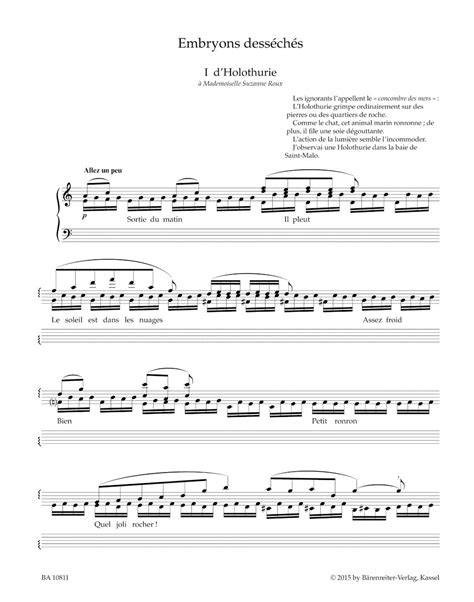
Embryons desséchés: II. d'Edriophthalma
Dokumentace a literatura k osobnosti skladatele: Vladimír Štěpánek - Francouzská moderní hudba; Jiří Vysloužil - Hudobníci 20. století; Lenka Foltýnová - Erik Satie, podivín z Arcueilu. Koncerty v Praze a Kroměříži ukazují, že zábavná a provokativní stránka Satieho tvorby stále zůstává živá a inspirativní pro publikum i současné skladatele.